Twenty-nine small drawings, made in a few seconds each. This is what they became once I started calling them configurations.
Nothing has been added to them. Everything here is a way of reading what was already there.
These drawings sat in my archive for years. I made them long ago, very quickly, and I always liked them, but I never knew what to do with them. Around the time I made them I was reading Alfred Jarry. I didn't think of him while drawing, but I'm sure he's in there somewhere.
Recently I brought them to AI to explore what they could become. I had no plan. The key moment came when we started calling them configurations: arrangements of the same few parts. That one word changed how I looked at them, and everything else grew from it: the grammar, the character set, the script, the font and the minutes.
This is one such exploration, developed under assembleStudio, my independent practice.
Abraham Espinosa assembleStudio · Turin, November 2026 · As 154
The experiment
The drawings followed a few rules, meant to suspend conscious authorship and let form come from constraint and speed:
- Two colours, red and black
- Small vignettes, one on each sheet
- No predetermined subject
- A few seconds each, with no time to rationalise or correct
- The aim: a unique form every time
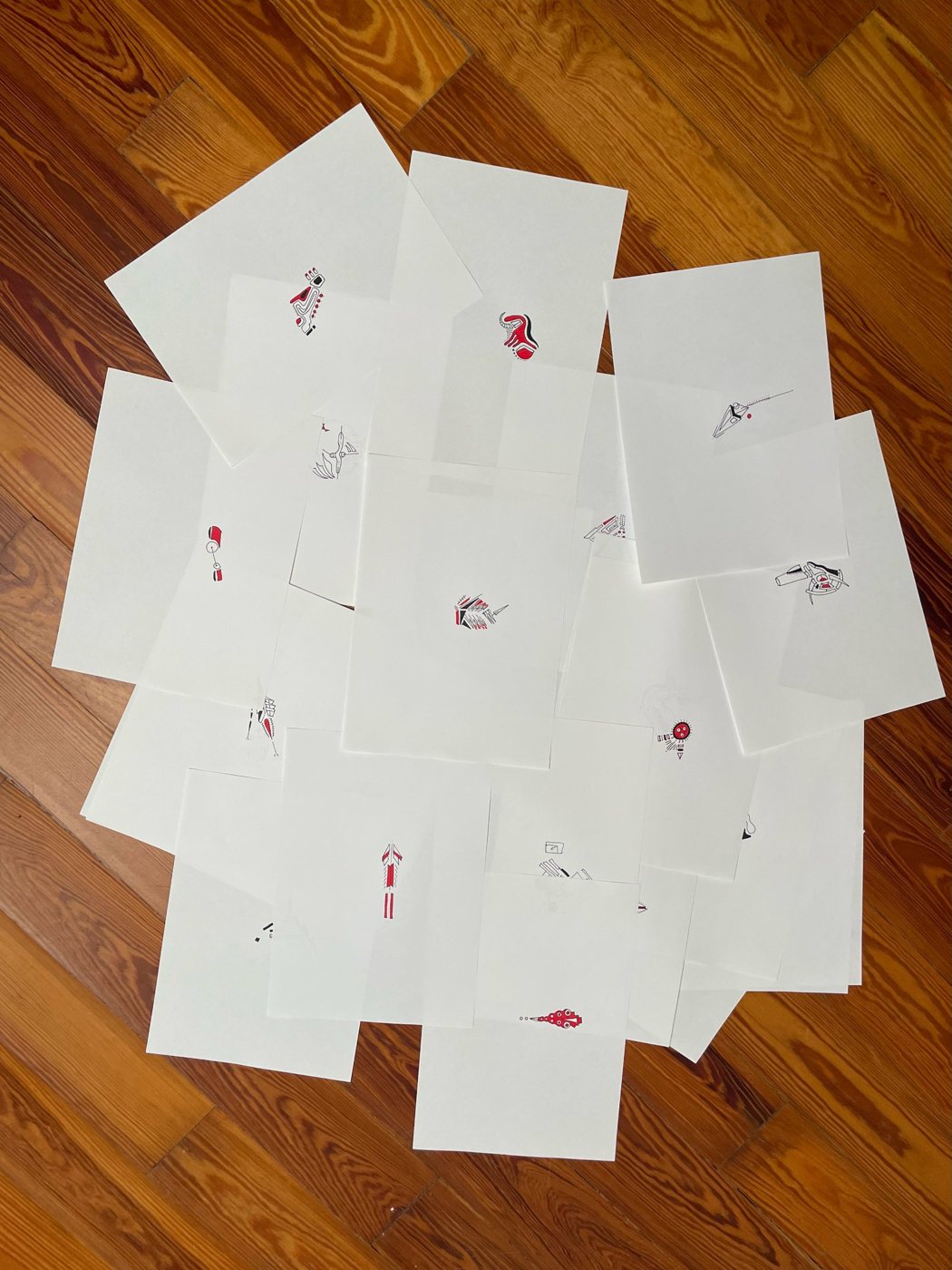
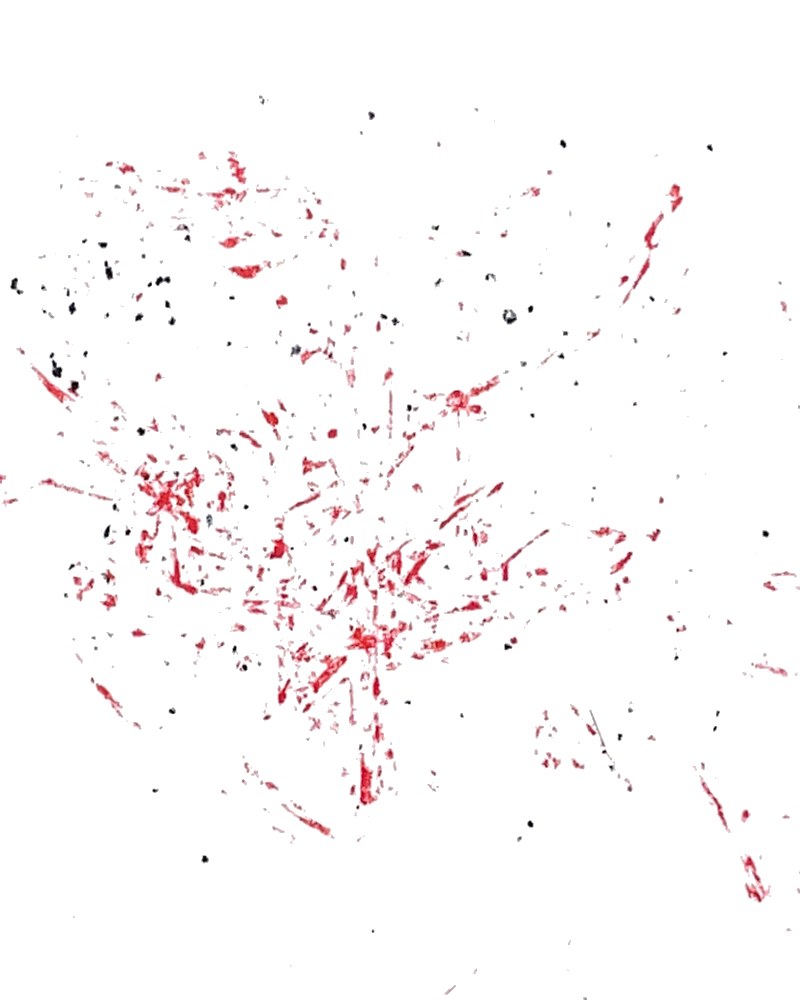
Two bodies of material came out of it: the 29 drawings, and the sheet underneath them, which collected the marks of the drawing process.
Why I did this
I wanted to find out what these drawings could become without changing them. Most of what happened afterwards was organising them: deciding what they are, what to call them, how to find them and how they relate.
Looking back, this is information architecture. It works at several levels, and each one is shown in the sections that follow.
- Scope
- The first decision was the key one: a closed set of 29 drawings plus the trace sheet, with nothing new generated. That sets the boundary of the information space.
- Classification
- Tokens, elements, relations and configurations form a layered model, like atoms, molecules and compounds. The three primitives sit underneath it all.
- Vocabulary
- 16 named elements and 10 relations form a fixed list of terms. Every description is built from that list, which makes the descriptions comparable.
- Naming
- Each name has four syllables, one per facet: dominant primitive, direction, footprint and most distinctive element. FAROK-AN holds all four in one word, the way a library call number does.
- Identity
- Each configuration has a fixed code, a formal name that never changes, and aliases. As in Unicode, identity is kept apart from appearance: a character is not its glyph.
- State
- N, E, S and W, counted from each configuration's own north, give a shared way to describe orientation that any configuration can carry.
- Navigation
- The site moves from overview to detail to use: cover, code chart, individual entry, then script, font and uses.
Together, these levels turn an unlabelled archive into a system people can name, search, compare and use.
Jarry invented 'pataphysics, “the science of imaginary solutions”. Where science looks for laws that hold everywhere, 'pataphysics studies the exception, the one-off case. These drawings are exactly that: twenty-nine exceptions. Everything here, the grammar, the codes, the font, the minutes, applies exact rules to them with complete seriousness, for no practical reason: a small 'pataphysical machine.
The set
The set is closed: 29 configurations and one trace sheet. Each drawing is a configuration, one arrangement of the same few things. Configurations are described, not extended. Each one is an exception: it happened once, and the set treats it as a rule.
Why configurations
A configuration is an arrangement of parts in a particular state. The word was chosen over drawing, form or specimen for four reasons.
- It names the structure. “Drawing” names the object on paper. “Configuration” names what the analysis is about: which parts are present and how they relate.
- It carries no metaphor. “Specimen” would make the set biology, “compound” chemistry, “word” language. A configuration is just an arrangement, so every reading stays open.
- It fits a fixed vocabulary. All 29 are built from the same three primitives and a small set of elements. What differs between them is the arrangement.
- It follows the rules of the set. Two arrangements that differ only in orientation or position are the same configuration, as the experiment's principles require. Scale is not set aside in the same way: it is a constraint every configuration keeps.
The term also comes with a picture from physics: the space of every possible arrangement, in which each actual state is one point. Seen this way, the set is 29 points in a much larger space, most of which was never visited.
| Variable | Principle |
|---|---|
| Orientation | Free. A configuration has no fixed up; it can be read from any side. |
| Position | Free. Where a drawing sits on its sheet carries no meaning. |
| Scale | Deliberately small. Every drawing occupies a few percent of its sheet; none is enlarged to dominate. |
The small scale is what makes the freedoms possible: far from the sheet's edges, nothing has an up or a corner. Below, all 29 at their true relative size.
The trace sheet, U+E000, is the exception to these principles: the one place where all 29 exist together, and the only place where position carries information.
Three primitives
Every configuration is made of dot, line and filled space: zero, one and two dimensions. They shade into each other with scale. A dot enlarged becomes filled space; a line given width becomes filled space.
Colour follows one rule. Red filled space is always held by a black line; black can stand alone. The two colours behave like substance and vessel.
Grammar
The grammar describes how each configuration in the closed set is put together, the way the grammar of an ancient language describes the texts that survive. It works in layers.
| Layer | Unit | Example |
|---|---|---|
| Tokens | dot, line, filled space | a short stroke |
| Elements | recurring compounds of tokens | a fringe: repeated short strokes along an edge |
| Relations | how elements combine | a cell grown from a channel's edge |
| Configurations | one complete arrangement | form 21 |
Elements
| Role | Element | Made of |
|---|---|---|
| Bodies | Mass | filled space held by a closed line |
| Band | a line given width, hollow or filled | |
| Cell | a small rectilinear closed line | |
| Shard | tapering filled space | |
| Crescent | curved, tapering filled space, usually black | |
| Ring | a closed line around a dot or a fill | |
| Void | a white shape cut into a fill | |
| Modifiers | Fringe | repeated short lines along an edge |
| Dot row | repeated dots, often graded in size | |
| Echo | an outline repeated inside or beside itself | |
| Terminal | a mark at a line's end: fork, T or knob | |
| Connectors | Thread | a line joining or piercing bodies |
| Rays | lines spreading from a centre | |
| Marks | Zigzag | a sawtooth line |
| Cross | two crossing lines | |
| Fan | layered plates |
Several elements look like design conventions with their meaning removed: tick marks, grids, connectors, arrowheads, nodes. They likely come from years of design practice, carried into the drawings without their original purpose.
Relations
- grow
- a new body grows from the edge of an existing one, keeping one constant gap, δ
- inside
- one element is held within another
- abut
- two bodies touch without enclosing
- echo
- an outline repeats at the gap, and may close down to a single line
- pierce
- a thread passes through a body
- satellite
- a small body stands apart, near an edge
- array
- an element repeats in a row or grid
- chain
- a sequence grows or shrinks along a direction
- radial
- parts set out along directions from a core
- cup
- an open arc partly encloses a body
Rules
- Substance and vessel. Red filled space larger than a dot sits inside a black line.
- No free modifiers. A fringe, dot row, echo or terminal attaches to a body or a line.
- Anchored connectors. A thread has a body at one end or more; rays have a centre.
- Relative space only. No rule refers to up, left or a position on the sheet.
- Modest scale. A configuration stays within a few percent of its sheet.
A configuration, written out
δ = one constant gap
A  = band( axis = curve, width = broad → neck )
     echo( A, inward ) → line
     fringe( comb, along A's upper edge )
B  = grow( from A, at δ ) → cell, red on its far side
C  = grow( from A, at δ ) → taper, red, black core inside
D  = abut( A's neck ) → cell, black core inside
E  = 3 cells along D's edge, red tips
F  = chain of 5 red discs along A's lower edge, dots between
G  = satellite beside A: bar over square
Form 21, U+E015. Written this way and drawn again, the description gives back the same configuration at any orientation.
A character set
The set is encoded the way Unicode encodes writing. A character is an identity; a glyph is one way of drawing it. Each configuration is a character, and each drawing, at each orientation, is one of its glyphs. The encoding names and describes; it never says what a character means.
Why Unicode
Unicode, together with its twin standard ISO/IEC 10646, the Universal Coded Character Set, gives every character of the world's writing systems a single number, so that text can move between devices and programs without losing its letters. It covers well over a hundred thousand characters across more than 150 scripts.
Encoding the configurations in its terms means borrowing the principles that make it work.
| Unicode principle | In Unicode | Here |
|---|---|---|
| Characters, not glyphs | A character is an abstract identity; how it looks belongs to fonts. | The configuration is the character; each drawing, at each orientation, is one of its glyphs. |
| One number each | Every character has a code point. | U+E000–U+E01D |
| Names that never change | Once published, a formal name is fixed; mistakes are corrected with aliases. | The same rule for the formal names. |
| Meaning left open | Characters are named and described; what a text means is left to its readers. | The set keeps its meaning open the same way. |
| Variation sequences | A character followed by a variation selector asks for a particular form of it. | VS1–VS4 give N, E, S and W. |
| Private Use Area | U+E000–U+F8FF is set aside for characters defined by private agreement; Unicode will never assign them. Invented scripts have long lived there, as Tolkien's Tengwar and Klingon did in the ConScript Unicode Registry. | The set occupies the first 30 places. |
The Private Use Area has one consequence: no standard font knows these characters. Wherever the font is not installed, they show as empty boxes, which is why the Font tab can also copy text as an image.
This block
| Block | U+E000–U+E01F, in Unicode's Private Use Area |
| Codes | U+E000 plus the form number in hexadecimal; form 21 is U+E015. U+E000 is the trace sheet. |
| Names | one formal name per character, fixed once assigned, plus a descriptive alias and a binomial alias |
| Orientations | N, E, S and W, clockwise from the configuration's own north: the way it points if it is polar, otherwise the top of the scan |
Formal names
| Syllable | Encodes | Values |
|---|---|---|
| 1 | dominant primitive | fa fill · li line · mi mixed |
| 2 | direction | ro polar · on radial or none · el weak |
| 3 | footprint | k under 3.5% · s 3.5–5% · t over 5% |
| 4 | most distinctive element | an ring · ba band · ce cell · ek echo · fi fringe · ku cross · lu crescent · pu dots · ra rays · sa shard · te thread · to terminal · va fan · zi zigzag |
Form 13 is fa + ro + k + an: CONFIGURATION FAROK-AN.
The script
A character set needs a way of being written. The script is that step: it puts configurations together into larger units, the way letters form words.
Its unit is the block: four different configurations in a 2 × 2 square. The square comes from scripts that build each sign from several parts, such as Korean hangul, where every syllable is a block of letters. Here the parts are configurations, so the block sits one level above them: a configuration of configurations.
Orientation does the work that spelling does elsewhere. The drawings never had a fixed orientation; in the script, that freedom becomes a value. Each configuration faces N, E, S or W, so the same four can be written in 256 ways. With 29 to choose from, there are more than 145 million different blocks.
The four are not independent. Turn one and the others move with it, like linked gears or compass needles close together. A block is a small system, and the boards record its state at one moment: under each configuration, its code and the orientation it faces.
No meanings are assigned. This is writing in form only, what is called asemic writing: it can be read for structure, rhythm and direction, but not decoded: an imaginary solution, in Jarry's sense.
How it moves
- Touch one configuration and it turns a quarter turn clockwise.
- The push reaches its two neighbours next, turning them the other way, like meshed gears, and the diagonal last, turning it the same way.
- Each moves like a compass needle: it overshoots, swings back and settles. Larger configurations are heavier and slower; lighter ones sometimes carry on for a full turn.
- A new block arrives inside a fast spin: the current four whirl, and the new four appear at full speed and slow to rest.
Minutes
A block turns freely. Fixed to a moment and attached to something written, it stops turning and becomes a minute. The name comes from Jarry's first book, Les Minutes de sable mémorial, which plays on the word's two meanings: a minute is both a measure of time and the original of a written record, the copy a notary keeps.
Counted from 1 January 2026, every minute until 2303 already has its own block. I will use them in my email: everything I write from assembleStudio will carry, under my signature, the minute it was written, also dated in the Ère Pataphysique. A reply keeps the minute of its thread.
Over the years, the minutes I use will trace my correspondence: a small fraction visited, most never written.
How this was made
Every image here is a scan of an original drawing, or a trace of one.
Everything else was made in conversation with Claude, an AI model by Anthropic, over a few sessions in November 2026. I brought the scans and the questions. Claude measured the drawings, suggested words and structures, and built these pages, the script, the font and the minutes.
The decisions were mine: what to keep and what to drop. Some ideas were tried and left behind, such as using the grammar to generate new forms.
The descriptions are one way of reading the drawings, not the only one.
Colophon
- Drawings
- Abraham Espinosa, red and black felt-tip on paper
- Studio
- Developed under assembleStudio, Abraham Espinosa's independent practice, Turin
- Developed with
- Claude, November 2026
- Series
- Experiments · 01
- Font
- Configurations, traced from the scans; licensed CC BY-NC 4.0
- Text type
- Zen Kaku Gothic New and Inconsolata
- Related work
- Alfred Jarry and the Collège de 'Pataphysique · On Kawara · Roman Opałka · asemic writing · the ConScript Unicode Registry
- Calendar
- Gregorian, and the Ère Pataphysique, counted from Jarry's birth on 8 September 1873